


By Mei Hua Legal Team (Thailand Lawyers for Chinese Investors)
In recent years, Thailand has emerged as a premier Southeast Asian destination for Chinese enterprises, especially in sectors such as Electric Vehicles (EV), Electronics, AI, Data Centers, Logistics, Medical Devices, Advanced Manufacturing, Food Processing, and Renewable Energy.
Our legal team regularly advises Chinese corporations and investors expanding across ASEAN. In our experience, the driving factor behind choosing Thailand over regional competitors consistently points to one core advantage: the substantial incentives and legal certainty offered by the Thailand Board of Investment (BOI).
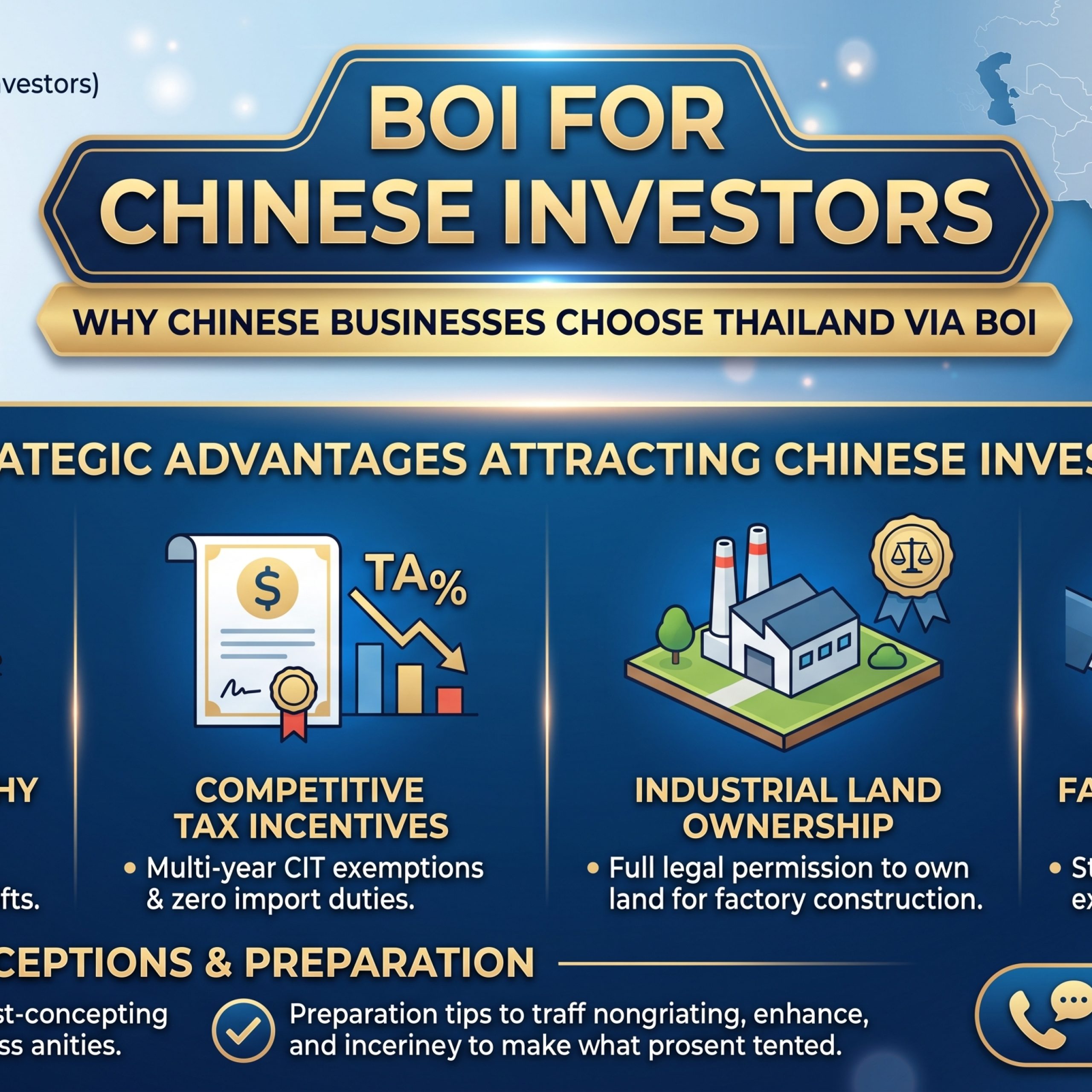
4 Strategic Advantages Attracting Chinese Investors to Thailand
| Strategic Pillar | Core Benefits for Chinese Enterprises |
| 1. Strategic Geography & Supply Chain | Seamless multimodal connections (R3A highway, maritime, rail) supporting China+1 supply chain shifts. |
| 2. Competitive Tax Incentives | Multi-year Corporate Income Tax (CIT) exemptions and zero import duties on machinery/raw materials. |
| 3. Industrial Land Ownership | Full legal permission to purchase and own industrial land for factory construction. |
| 4. Fast-Track OSOS Visas & Work Permits | Streamlined Non-B visas and work permits for Chinese executives and technicians with flexible hiring ratios. |
1. Geographic Connectivity & China+1 Supply Chain Integration
Thailand occupies a strategic location at the heart of ASEAN. With multimodal transportation corridors connecting Southern China via road networks (such as the R3A route), maritime routes, and high-speed rail developments, Thailand represents the top choice for companies executing a China+1 strategy—particularly manufacturers of EV components, precision electronics, and industrial appliances.
2. High-Yield Fiscal & Tax Incentives
BOI-promoted entities can secure Corporate Income Tax (CIT) exemptions for up to 13 years, alongside zero import tariffs on production machinery and export-bound raw materials. Compared with alternative manufacturing destinations across Southeast Asia, these tax waivers substantially lower capital expenditure and operating overheads across the initial 5 to 8 operational years.
3. Direct Land Ownership Rights
Under Thai law, foreign-majority entities are strictly prohibited from owning land. However, obtaining a BOI Investment Promotion Certificate grants qualified foreign enterprises the legal authority to own land for factory sites and commercial facilities, eliminating the uncertainties and costs associated with long-term land leases.
4. Streamlined Visas & Work Permits for Chinese Management
Relocating key executives, engineers, and technical personnel is often an operational bottleneck for foreign companies. BOI-certified entities utilize the One-Stop Service Center for Visas and Work Permits (OSOS), drastically cutting processing times for Non-Immigrant B visas and work permits while providing relief from standard Thai-to-foreign employee quota requirements.
Common Misconceptions Among Chinese Investors
- “Company registration automatically grants BOI status” — Business incorporation and BOI promotion are separate legal procedures; BOI status requires formal approval through the e-Investment system.
- “Any business category can obtain BOI” — Promotion is strictly limited to targeted eligible activities defined under the BOI investment schedule.
- “Applying for BOI is merely filling out forms” — BOI projects intersect with multiple regulatory bodies, including the Foreign Business Act (FBA), Land Code, Factory Act, and Department of Employment rules.
- “Chinese or English contracts can be submitted without translation” — Thai administrative bodies require certified Thai translations for all official cross-border documents.
What Chinese Investors Should Prepare Before Consulting Legal Counsel
- Preliminary Business Plan: Product specifications, planned production capacity, target export vs. domestic markets.
- Estimated Capital Budget: Total project investment value and verifiable sources of funding.
- Target Corporate Structure: 100% foreign-owned subsidiary vs. local joint venture.
- Key Personnel Roster: Number of Chinese executives, technical leads, and specialists relocating to Thailand.
- Site Selection Requirements: Target industrial estate, purchase criteria, or leased factory requirements.
With these initial project parameters, our legal counsel can evaluate which BOI category best fits your enterprise and structure a compliant corporate framework from day one.
How Mei Hua Legal Supports Chinese Enterprises
Mei Hua Legal Team provides full-spectrum legal advisory to corporations and investors from Mainland China, Hong Kong, Taiwan, Singapore, and Malaysia. Our services include BOI Application Management, Thai Company Registration, Cross-Border Corporate Structuring, Factory & Land Compliance, and OSOS Visa/Work Permit Support.
Related Guides: [What is BOI? Complete Overview] | [BOI Application Procedure 2026: Step-by-Step] | [100% Foreign Ownership via BOI: Legal Feasibility]
Schedule a Preliminary Consultation with Mei Hua Legal Team
Thailand Legal Advisors for Chinese Cross-Border Enterprises
Disclaimer: This article is provided for informational purposes only and does not constitute formal legal advice. Consult qualified legal counsel regarding specific corporate matters.
Frequently Asked Questions (FAQ)
Why is Thailand preferred for the China+1 manufacturing shift?
Thailand provides strategic overland and maritime logistics routes connecting to Southern China, mature automotive and electronics supply chains, and comprehensive BOI tax exemptions.
Can a Chinese manufacturing company own land in Thailand?
Yes. Once granted BOI investment promotion, foreign-majority or 100% Chinese-owned manufacturing enterprises receive legal authorization to purchase and own industrial land for factory operations.