By Mei Hua Legal Team (Thailand Lawyers for Chinese Investors)
Many Chinese investors who contact us frequently ask the same question: “How do we apply for BOI, and how long does it take?” This article summarizes the main steps for applying for BOI investment promotion in a clear, straightforward manner to help you plan your project with confidence.
Note: BOI criteria and application forms are updated periodically. The timelines mentioned below are general estimations. Always confirm the latest guidelines with a legal advisor or check the official website boi.go.th prior to formal submission.
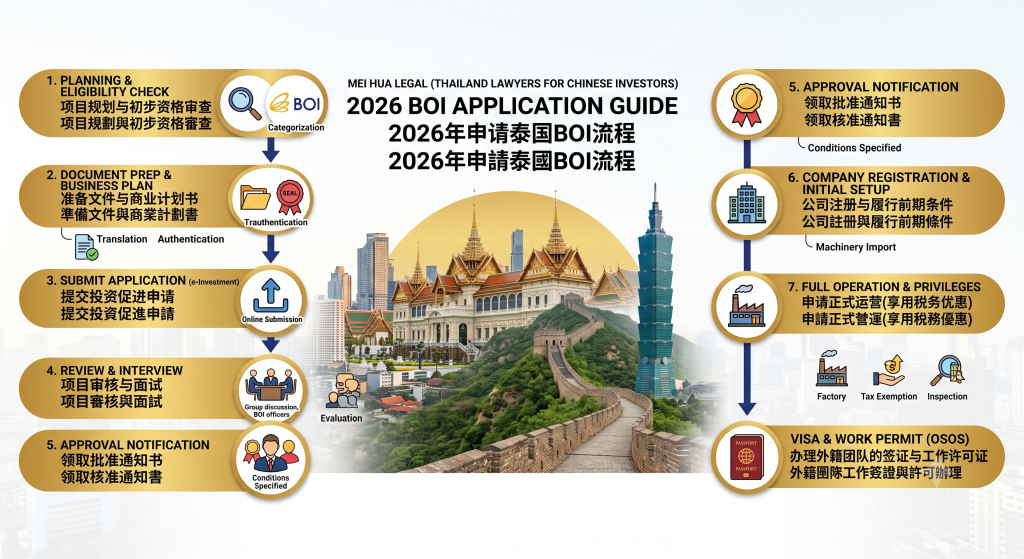
Step 1: Project Planning and Preliminary Eligibility Verification
Before submitting an application, verify whether your business category is listed under the BOI promoted activities. Evaluate your investment value, production capacity, and imported technology. This stage should be conducted in consultation with experienced lawyers or advisors to select the appropriate promotion category and establish a compliant corporate structure from the start.
Step 2: Document Preparation and Business Plan Creation
Key required documents generally include: a comprehensive business plan, investment budget, shareholder structure, parent company profile (if operating as a subsidiary of a Chinese group), and official corporate legal documents from China authenticated via Notarization and Legalization by the Thai Embassy/Consulate.
Step 3: Submitting the Investment Promotion Application
BOI applications are currently submitted through an electronic system (e-Investment). Applicants must fill out detailed project parameters, attach supporting documents, and pay designated fees. Legal counsel typically performs a thorough audit prior to submission to minimize the risk of document rejections or supplementary requests.
Step 4: Application Review and Project Interview
BOI officers evaluate the proposal based on key metrics: economic value addition, technological level, local employment, and environmental impact. For large-scale or complex projects, BOI may request an interview or additional clarifications, where your legal representative can participate and present on behalf of the company.
Step 5: Receiving the Approval Notification
Upon approval, the BOI issues an official Notification of Approval, outlining specific conditions, deadlines, and requirements (e.g., the deadline to commence full operation).
Step 6: Company Registration and Fulfilling Conditions
If the entity in Thailand has not yet been registered, you must register the company according to the approved structure. Subsequently, proceed with machinery import, factory site acquisition, and initial setup according to the proposed plan.
Step 7: Exercising Privileges & Full Operation License
When the facility is ready for actual commercial operations, the company must apply for “Full Operation” status with the BOI to activate tax incentives and other benefits officially. BOI officers will verify whether actual production capacity and investment amounts match the approved terms. Discrepancies may require project amendments, making continuous legal monitoring essential from application to full operation.
Step 8: Visas and Work Permits for Foreign Key Personnel
In parallel with the operational setup, BOI-promoted entities can utilize the BOI One-Stop Service (OSOS) to obtain Non-Immigrant B Visas and Work Permits for Chinese executives, engineers, and specialists much faster than through standard channels.
Common Pitfalls for Chinese Investors
- Inaccurate Projections: Miscalculating investment value or production capacity in the application, leading to compliance issues during the final operation inspection.
- Document Authentication Errors: Failing to properly translate or legalize parent company documents from China according to BOI requirements.
- Non-Compliant Equity Structures: Selecting shareholder proportions that violate specific BOI category requirements.
- Missing Key Deadlines: Neglecting post-approval compliance tracking and missing mandatory operational milestones.
Summary
The BOI application process touches upon multiple legal jurisdictions—from corporate structuring and registration to visa and work permit compliance. Engaging legal counsel fluent in both Thai law and Chinese corporate practices ensures a smooth process and mitigates risks of costly delays.